
From Coin to Wheel: How the Cities of the Chuy Valley Made Their Own Money
A guest contribution based on the research of Dr. Alexander Kamyshev, Bishkek
[Фото 1]
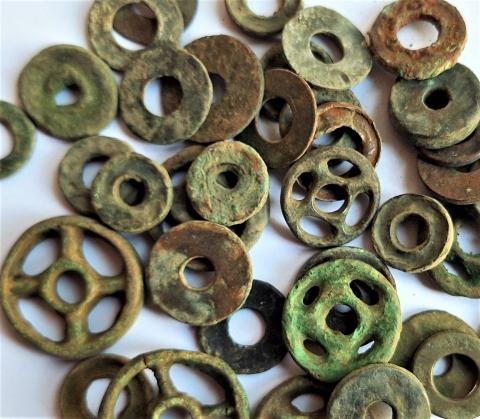
From a recognisable Tang coin to a bronze wheel: local imitations of the „kaiyuan tongbao“ from the Chuy valley, 9th to 10th century. Photos: A. M. Kamyshev
What makes an object money? At the ASC we ask this question every day. A recent study from Kyrgyzstan answers it in a surprising way: with bronze discs that look like washers, little wheels and swirling ornaments, and that began their life as copies of Chinese coins.
The numismatist Dr. Alexander Kamyshev has spent more than two decades studying the local imitations of Tang dynasty coins found in Semirechye, the „Land of Seven Rivers“ in today's Kyrgyzstan and southeastern Kazakhstan. His results show how a city economy can keep money circulating when no state is minting it.
A coin that travelled west
The Chinese „kaiyuan tongbao“ was cast for about 340 years, beginning in 621. It was round, with a square hole and four characters. In the middle of the 9th and the beginning of the 10th century, under the rule of the Karluk Khaganate, the cities of the Chuy valley began to cast their own bronze imitations of these coins.
The coin was widely used along the Silk Road. According to Kamyshev, the people of Semirechye knew Tang coins almost a hundred years before the region issued its own money. When the Türgesh Khaganate reformed its coinage in the first half of the 8th century, its first coins matched the Tang coins in weight, size and shape: the Chinese coin system was the model.
Why? Kamyshev describes the background: the earlier local coins of the region had shrunk through inflation to a diameter of 8 mm and a weight of 0.1 g. Coins like that were barely usable. To keep money circulating, the cities turned to a coin type that was still popular: the Tang coin.
A forgotten group of coins
For a long time, these imitations did not interest specialists. One reason was their low information value. Another was political. The excavations at Krasnaya Rechka (1978 to 1983) produced 226 coins, but only 8 Tang coins and not a single local imitation. Kyrgyzstan's leading archaeologist V. D. Goryacheva later told Kamyshev that Chinese coins were not to be included in the excavation reports, because relations with China were still tense in the 1970s and 1980s.
When Kamyshev first published the Semirechye imitations in 2000, the reaction was strong. Many researchers refused to accept them as money at all.
How a coin becomes a wheel
More than half of the Chinese-type coins found in Semirechye deviate so clearly from genuine Tang coins that Kamyshev groups them separately as local imitations.
Kamyshev sorted the finds from Ak-Beshim (Suyab, the capital of the Turkic khagans), Krasnaya Rechka (Navekat) and Burana (Kuz-Ordu) by how far they had moved away from the original. At first, original „kaiyuan tongbao“ coins were pressed into the casting mould. With every new casting the deviations grew, until the characters were replaced by round dimples and the coins took on the form of washers and wheels.
Group 1: characters slightly blurred but still readable, 23 to 25 mm, square hole.
Group 2: round hole of 8 to 11 mm, often only the character „yuan“ is recognisable.
Group 3: the largest group, 19 to 22 mm, characters can only be guessed.
Group 4: instead of characters, eight or more dimples, open spokes or swirl patterns. These are the pieces some researchers preferred to call spindle whorls or talismans.
[Фото 2]
Wheel with four spokes, type M.4b. Photo: A. M. Kamyshev
[Фото 3]
Swirl ornament, type M.4g. Photo: A. M. Kamyshev
Nuzket and its heavy coins
Over the last twenty years, new finds have changed the picture. At Shish-Tyube, one of the largest sites in the western Chuy valley north of today's Kara-Balta, identified with the early medieval city of Nuzket, 106 local imitations were found. More than half of them are heavy cast pieces, up to 6 mm thick, which had previously appeared only as single finds elsewhere. New wheel types with 4, 6 and more spokes also appeared, with diameters of 23 and 28 mm.
Because these heavy types are concentrated at Shish-Tyube, Kamyshev concludes that they were made in Nuzket itself.
[Фото 4]
Heavy imitation, type M.4a, up to 6 mm thick. Photo: A. M. Kamyshev
Money without a state
The most important result is this: the imitations were not issued by the Karluk state. A statistical analysis of the find places shows that coins from the western cities of the Chuy valley rarely reached the eastern ones, and the other way round. Each city made money for its own needs.
Some details make this even clearer. Lead coins make up almost 5 percent of the complex, which points to counterfeiting or, more likely, to a lack of any official control over coin production. And around Taraz, which came under the Samanids in 893, no local Tang imitations have been recorded at all. There, coins of the Islamic type took over. In the cities of the Chuy valley, the local imitations continued until the Karakhanids came to power and also adopted Islamic coinage.
[Фото 5]
Typological overview of the local imitations. Drawing: A. M. Kamyshev
Why this matters for the ASC
The Alex Schütz Collection brings together 2,210 objects from 40 countries and about 9,000 years, documented in „Ethnographische Geldformen“ by Karl F. Stifter (3rd edition, 2020). Many of them sit on the same border that Kamyshev's wheels sit on: they do not look like coins, yet they worked as money.
The Chuy valley shows that this border is not only a question of shape. A bronze wheel without a single readable character was accepted in the market because the community trusted it. That trust, not the image of an emperor, made it money.
About the author
Dr. Alexander Mikhailovich Kamyshev is a Candidate of Historical Sciences, a member of the International Numismatic Club and of the Writers' Union of Kyrgyzstan. He took part in excavations in the Chuy and Issyk-Kul valleys and at Tash-Rabat, taught numismatics at the Kyrgyz-Russian Slavic University for more than ten years and has written ten books and more than 260 articles, among them „Early Medieval Coin Complex of Semirechye“ (2002) and „Numismatics of Kyrgyzstan“ (Bishkek, 2024).
His work, in Russian, is published on karahanid.com. This post is based on his article „Local Imitations of Tang Dynasty Coins in the Monetary Circulation of Semirechye“. His paper on the finds was presented at the conference of the International Numismatic Club in 2022, and a comparative study appeared in Almaty in 2023.
With many thanks to Dr. Kamyshev for sharing his research and photographs with the ASC.
Краткое содержание на русском
В IX и начале X века города Чуйской долины, в период правления Карлукского каганата, отливали собственные бронзовые подражания китайским монетам династии Тан «кайюань тунбао». С каждой новой отливкой иероглифы теряли чёткость, и монеты превращались в «шайбочки» и «колесики». Статистический анализ находок, проведённый А. М. Камышевым, показывает, что эти подражания не были общегосударственными выпусками: их выпускали городские центры для местных нужд. Особенно интересны тяжеловесные монеты и «колесики» с городища Шиш-Тюбе (Нузкет). Подробнее на сайте karahanid.com.
Follow the ASC
Substack: sonjaschromm.substack.com
Wattpad: What We Owe, Owned: Alex Schütz Collection
LinkedIn: Sonja Schromm